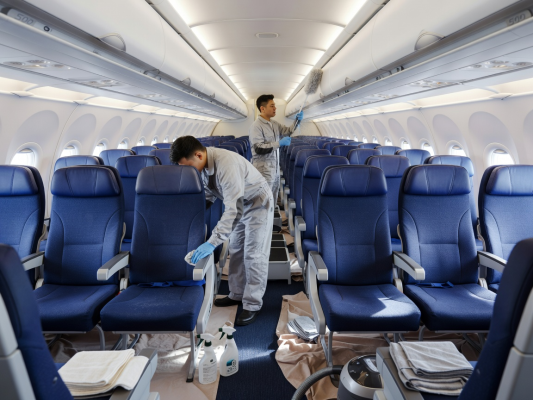
The Scope of Deep Detailing
While turnaround cleaning deals with the immediate presentation of the aircraft for the next flight, cabin detailing is a scheduled, comprehensive service designed to restore the cabin to a premium standard. This process evaluates and addresses passenger seating areas, overhead storage, floor conditions, and sensitive galley and lavatory environments.
Passenger Seating and High-Touch Surfaces
The passenger seat is the focal point of the inflight experience. Detailing involves thorough cleaning of tables, tray surfaces, armrests, and seatback screens. Care must be taken to ensure that cleaning agents used on screens do not damage anti-glare coatings, while tray tables require robust wipe-downs to remove residues.
Upholstery and Floor Care
Different materials require different care approaches. Leather seating demands specialized conditioning to prevent cracking over time, while fabric upholstery may require vacuum extraction to deal with deeply embedded dust and minor spills. Floor care extends beyond vacuuming to include spot-treatment of carpets and the thorough mopping and drying of hard flooring in galley and aisle transition areas.
What to Know: General Cleaning vs. Detailing
General cleaning removes visible debris and resets the appearance. Detailing involves treating materials to prolong their lifespan, addressing minor stains, managing long-term odor accumulation, and ensuring that hidden areas (like seat tracks and storage bin corners) are free of dust buildup.
Galley and Lavatory Focus
Galleys and lavatories are critical zones. Galley detailing involves degreasing surfaces, cleaning oven interiors (where permitted by operator procedures), and ensuring all storage latches and tracks are free of sticky residue. Lavatory detailing focuses on deep cleaning of sinks, mirrors, and floor areas, along with effective odor management to ensure a fresh cabin environment upon boarding.
Cabin Panels and Odor Management
Side panels, window blinds, and ceiling panels can accumulate dust and static-attracted grime. Wiping these down brightens the cabin significantly. Effective odor management relies on neutralizing sources of smell—such as lavatory zones and carpet spills—rather than simply masking them with strong fragrances, which can be overwhelming in a pressurized cabin.
Detailing Checkpoints
- Seating: Seatbacks, belts arranged, leather/fabric treated, screens wiped.
- Storage: Overhead bins wiped down, tracks clear of debris.
- Floors: Carpets vacuumed and spot-treated; hard floors cleaned.
- Galleys: Work surfaces degreased, metallic surfaces polished.
- Lavatories: High-touch areas wiped, mirrors streak-free, floors dry.
Note: We do not make unsupported claims about pathogen elimination, medical sterilization, or regulatory health compliance. Our focus is on the meticulous visual and physical presentation of the cabin materials.